
Smartwatches monitoring your heartbeat level and blood pressure and fitness bracelets tracking your daily activity don’t surprise anyone today. Wearables firmly entered our lives and don’t seem to be something fantastic; it’s a commonplace in the modern world.
However, the idea of wearables is continuously evolving, and such devices find application in a variety of areas, sometimes in the most unexpected ones. Backed by machine learning and computer vision, wearables transform into powerful accessories that are able not only to gather data but also to analyze it in the blink of an eye.
So, wearable IoT devices. How do they push the boundaries of innovation? What are their working principles and application areas in addition to the usual ones? Are there things to be considered when opting for IoT development services? That’s what we are going to talk about in this blog post.
Understanding IoT Wearables and Their Use Purposes
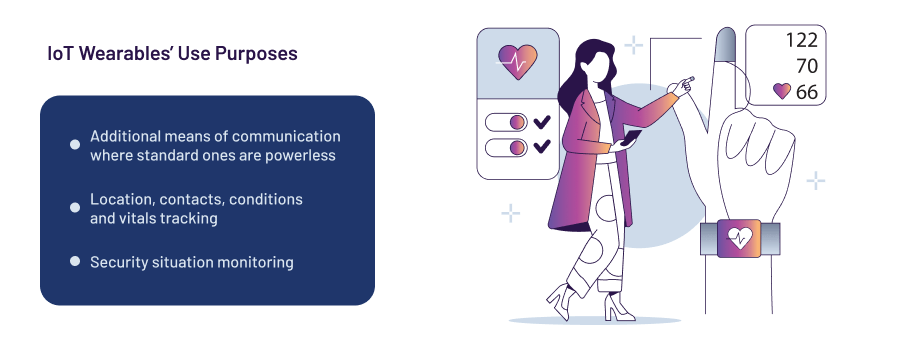
As a rule, IoT wearables are devices intended to be worn on a living being, say, a human or an animal. Although potentially, they can be designed also for robots moving along warehouses and carrying goods. Let’s consider some IoT wearables examples and use purposes to have a better understanding of their capabilities.
Additional Communication Avenues
We all have smartphones at hand, why do you include communication here, you may ask? Indeed, globally this problem had been resolved more than a decade ago. However, zones out of the cell coverage still exist, and IoT wearables might do a great job here.
For example, if we speak about rescue operations somewhere in the mountains or underwater. Little chance that rescuer’s regular smartphones will function in such locations, right? Another vivid example applies to miners working deep underground. Agree, such conditions don’t contribute to stable connection either.
Tracking Capabilities: Location, Contacts, Conditions, and Vitals
Vitals tracking, such as blood pressure, pulse, and body temperature, still remains the most common wearable IoT device use purpose, although we got used to it long ago. So, let’s dwell on location, contacts, and conditions tracking more specifically in this part.
During the pandemic, location and contact tracing of infected people became especially relevant. For example, owing to a specific application, it was possible to track if a COVID-positive person left their home or contacted other people.
How? As a rule, such devices are equipped with Bluetooth sensors, just like our smartphones. When a virus carrier appears a few meters away from a conditionally healthy person, their devices — the wearable and the phone — detect each other, transmitting the signal of the contact.
Conditions tracking is another essential use purpose of IoT wearable technology. Let’s imagine a lab technician, dealing with radioactive materials daily. Taking note of dangerous working conditions, they are obliged to carry devices able to give alerts if the concentration of hazardous substances in the air exceeds the permissible norms.
Security Situation Monitoring
Do you feel absolutely safe when coming back home late at night? Most probably, the majority of respondents would give a negative answer. And this is another valuable function performed by wearables — security situation monitoring.
Among our IoT projects, we had one implying the development of wearables intended for jogging enthusiasts. The device features an alarm button that, when pushed, launches audio and video recording. In case of an emergency situation, i.e. attack, the device transmits video, audio, and location data to the cloud in real time and gives alerts to the local authorities.
Thus, the wearable helps to capture assailants’ faces and identify them asap. Imagine, how long would it take if the police dealt with facial composites created from the words of a victim. Let alone the fact that it’s not an easy task by itself to recognize a person by a sketch.
IoT Wearables Usage: Going Beyond Standard Application Fields
As you can see, the use cases and capabilities of wearable IoT devices have expanded tremendously. With the rapid pace of technological development, just imagine what could be possible in a decade or two!
Next, let’s explore the application areas of IoT wearable technology. Some of these areas may not be immediately obvious, but from our point of view, they hold incredible potential.
Explore How IoT Embedded Systems Are Impacting Industries
Healthcare

Imagine a huge multi-building medical facility with ten floors each and hundreds of offices. This hospital has only several resuscitators worthing their weight in gold. The ambulance delivers a patient in critical condition, and every minute or even second counts. How to find the resuscitator in the endless labyrinth of the hospital’s corridors and offices?
With the help of special badges, of course! Indoor positioning systems require an ultimate level of accuracy, and this request was of paramount importance from the client’s side. Our team got down to work and assisted our customer in creating an ML-powered device able to identify the location within 10-60 seconds and with 90-95% accuracy. Additionally, we delivered an Android mobile application for tag emulation.
Read the full case study about Real-Time Location Tracking System Development
Industrial Use

What are the main risk factors for a person working at great depths? Oxygen deficiency, for instance. Since mining belongs to the group of regulated industries, miners are obliged to carry special devices, indicating that oxygen level is critically low or methane concentration is extremely high and there’s the risk of explosion.
As a rule, traditional equipment is quite clumsy, designed without any digital technologies, and can’t guarantee ultimate safety and reliability. Contemporary IoT wearable ensures instant conditions tracking and transmitting these data to the cloud for centralized monitoring.
Passenger Transportation and Freight Services

For example, it may be a device attached to the instrument panel. With a selected frequency, it signals, and a driver must push the button within 30 seconds, letting the operators know that everything’s fine and the trip goes as planned. If the driver didn’t perform the action, this indicates that an emergency had happened and immediate measures must be taken.
Learn 7 Reasons to Implement IoT in Transportation and Logistics
Sports

Such an approach helps coaches adjust their workout strategies with this or that athlete, prevent traumas, and improve players’ performance.
Assisted Living

Put simply, a wearable becomes the eyes of visually impaired or completely blind people. Therefore, they gain opportunities to move around a city and live a more fulfilling life.
Data Transfer Types. Select Yours for Ideal Device Creation
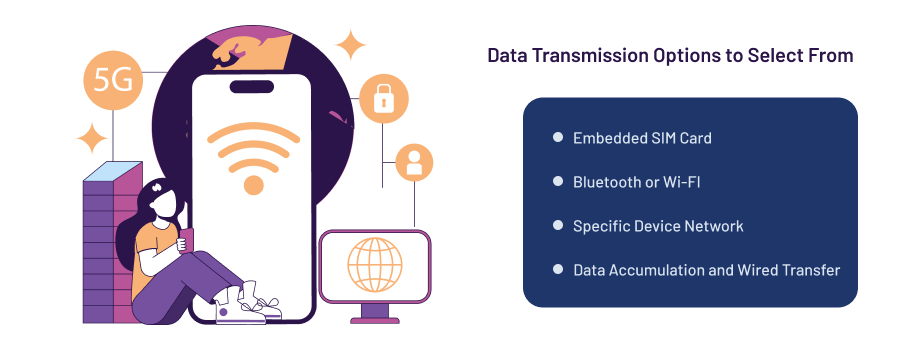
Naturally, we expect our wearable to interact with a server, a smartphone, or any other device somehow. First, it’s important to realize that connectivity is energy-consuming. Second, if your device directly connects to the GSM LTE network, you need a SIM card with at least minimal traffic volume.
From here follows the problem of traffic saving or the necessity of getting rid of this connectivity. Here, you can use the indirect method of data transmission. For example, via your personal mobile phone, which already has a SIM card and traffic volume. Thus, many wearable IoT devices feature Bluetooth or Wi-Fi to interact with smartphones and transmit data.
There’s also a way of data transmission not through a personal mobile phone, but via the entire network. Let’s remember the AirTag’s working principle. All Apple devices are equipped with specific services transmitting data from all nearby devices to a unified network. If your AirTag is in sight of a MacBook or iPhone, location details are transferred to the server.
The same connectivity method may be selected for Internet of Things wearables as well. But bear in mind that all the units must be equipped with a unique service to be able to transmit data, and they must be in sight of each other.
It’s not a problem in the case of Apple since almost every second one has their devices, and the probability that two units turn out to be nearby is quite high. This can’t be said about unique wearable technology products with limited quantities.
If continuous data transmission is not a must-have for you, there is a way to design a wearable that accumulates indicators and transfers them when connected to a laptop, phone, or any other device.
Say, you have a glucometer and need sugar levels only once or several times a day. It may not have a wireless interface and just record your vitals and transmit them when you connect it to a conditional laptop. Even though a wearable can’t be connected to the network, it has several indisputable advantages — no need to struggle with power hunger, and the design cost won’t be that high.
Striking the Balance Between Costs and Functionality. Challenges of IoT Wearables’ Design
Sure thing, the list of application areas we mentioned is far from complete, we’ve discussed only several notable use cases. However, although the IoT wearable technology has become widespread, its production is not a simple task. And here’s why.
Wearables Are Power-Hungry

When we speak about a wearable, we mean something small and compact. Therefore, it’s impossible to embed a huge battery in the device. Meanwhile, we expect it to be energy-efficient and multifunctional.
That’s exactly one of the most pressing challenges faced by developers — to design a small but at the same time feature-packed and power-efficient wearable. Imagine, your device records data and transmits them to the cloud non-stop. Add to this some ML models that drain power at every computational turn.
We are here to assist you in designing tailored IoT solutions.
Looking to develop cutting-edge hardware that fuels your business growth? Take your first steps right now!
Durability Issues

Security of a Wearable Itself

Thus, some of the wearables may require additional security measures. Say, alerting if the battery’s temperature exceeds a certain level.
If we speak about a regulated industry, such as healthcare, wearable devices may require certification, additional testing, or a regulatory process to be approved for use and sale.
Ensure Reasonable Cost of a Wearable

Striking the balance between cost, power efficiency, size, feature set, and security is the most pressing challenge IoT development service providers face. Currently, in our pipeline, we have a project on the design of a portable device intended for cancer detection at early stages. It implies emitting infrasonic waves and analyzing the response at high speed.
Our team got down to the project quite recently, and at the moment there is a step of finding a compromise between safety (since the device is implied to have high-voltage impulses and contact skin directly), compactness, power efficiency, and cost.
Things to Ponder As You Create a Wearable Device
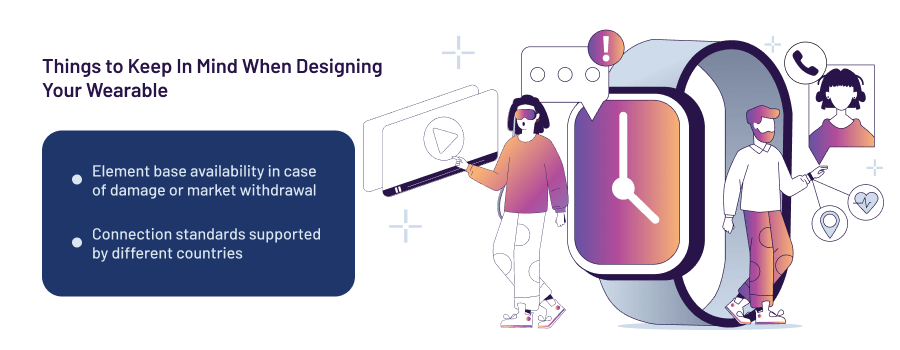
IoT Device Element Base Availability
Each component of your wearable IoT device may break down. It may be worn out or just damaged, and it’s essential to have a plan for the replacement of parts your device consists of.
Here we have several potential hurdles. First, elements may be worn out, become obsolete, be produced in limited quantities, or be withdrawn from the market at all.
For example, you created an IoT wearable with a powerful brand-new microchip. Over time, the manufacturer realized that the production of such kinds of chips was commercially unprofitable. Try to guess what’s their next step to take. It’s very unlikely that the company will operate at a loss even though they understand that this particle is critical for some of their customers.
That’s why it’s better to be prepared for the worst scenario when elaborating your IoT wearable’s element base. It’s reasonable to opt for long-living components or those that can be replaced quickly and painlessly.
Read a guide about IoT Hardware Development and Its Essential Considerations
Connection Standards and Geography
Several years ago, US operators announced the sunset for 2G and 3G connection standards. All the equipment was dismantled and bandwidth was freed up for other use. Put simply, all devices supporting 2G and 3G turned into pumpkins and stopped working in the United States at all.
However, it can’t be said about other countries, for example, China. Broadly speaking, such devices still can be used outside the US, although with peculiarities.
The issue is that in different countries communication bands function at different frequencies. Sure thing, if we implement a fancy iPhone-like connection module in our wearable, most likely the device will function smoothly almost everywhere, regardless of the location.
However, as a rule, nobody selects such expensive connection modules for wearables, many opt for cheaper options. Thus, it’s better to plan where your devices will be used and which connection standards they will support.

Business Analysis in IT
To Wrap It Up
We are living in a world where wearables can help detect health anomalies at early stages, assist people with disabilities to live a more fulfilling life, ensure a safe working environment, and many more. Agree, a decade ago it could be perceived as something fantastic and unachievable, but now it’s our reality.
However, the path of creating a specific, efficient, and feature-packed wearable device is thorny and long. Because finding a compromise between functionality, price, compactness, and power efficiency is far from easy.
At Velvetech, we offer a full spectrum of IoT development services. Our engineers designed multiple well-balanced IoT devices for a variety of industries and will gladly help you with yours. Velvetech also provides wearable app developmen`t services to complement IoT projects, ensuring seamless integration between devices and applications․ Drop us a line, we’ll help you bring your idea to life!