In recent years, artificial intelligence (AI) has been taking the tech world by storm, with more and more companies turning to this innovative technology to improve performance.
In fact, by 2030, the global artificial intelligence market is set to reach $2 trillion. An enormous number, considering the relatively recent popularization and adoption of this technology.
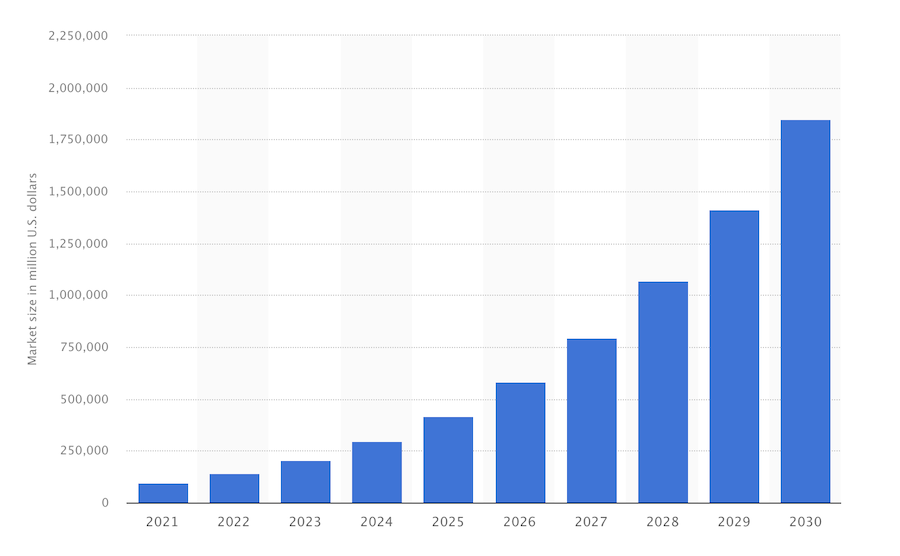
Yet, the AI market isn’t the only one that’s expecting growth in the coming years. The global mobile application sector is also experiencing great levels of success and is set to generate more than $781.7 billion in revenues by 2029. Hence, it comes as no surprise that AI and mobile applications have intertwined. Ultimately, the former can certainly enhance the latter.
So, today we want to discuss AI in mobile app development and take a look at its eight main uses that are bound to improve your solution. After all, as a business leader, it’s important to understand how emerging technologies can contribute to the performance of your organization. Let’s get started.
Key Highlights
- AI chatbots provide 24/7 support, thus both cutting labor costs and significantly boosting user satisfaction.
- Having their hands busy with other tasks, users may issue commands to AI-powered virtual assistants to simply get things done.
- AI is capable of adapting your app’s interface to individual preferences, thereby significantly enhancing the user experience.
- AI assists in recognizing and overlaying real-world objects into digital environments to create a realistic virtual interaction.
The Potential of AI in Mobile Application Development
Artificial intelligence is a technology created to mimic the human mind for tasks that require problem-solving and decision-making capabilities. Essentially, it is a field that relies on computer science and extensive datasets to carry out actions in a much quicker and more accurate manner than a human could.
Overall, AI is a broad term that also encompasses other subfields like machine learning, deep learning, natural language processing, neural networks, computer vision, robotic process automation, and other areas that rely on data and algorithms.
Interested in deep learning development services?
CONTACT USAI is already being used across a variety of industries, including healthcare, retail, finance, real estate, insurance, and more. There are endless opportunities for this technology literally in all business sectors, and mobile solutions are no exception.
Discover more AI Opportunities
Mobile apps gather enormous amounts of data and are thus prime for AI to come in and make the most of that digital information. While embedding AI into mobile apps is a relatively new process, it shouldn’t discourage business leaders from pursuing the undertaking.
So, let’s briefly go through the three key benefits that AI delivers when embraced in mobile app implementation.
Enhanced User Experience
AI helps user and customer interactions with your solution become more intuitive. In essence, it drives a more personalized experience. The intelligent algorithms allow for sentiment analysis and define emotions, which shape more opportunities for improving services and products.
Automated Operations
With AI-based features, mobile apps that complement enterprise software to manage daily business processes reduce manual work and automate mundane activities. As a result, this automation eliminates possible errors and leads to a high degree of accuracy, which is especially important when dealing with data.
Check out more Opportunities of Business Process Automation
Increased Efficiency
In most cases, AI-powered mobile apps perform tasks faster than a human can. Whether it is processing data, responding to customers’ queries, or managing some workflows, AI offers businesses a helping hand to increase efficiency.
You see, if artificial intelligence can boost automation, improve user experience, and deliver intelligent interactions for web applications, it can also do so for mobile. From chatbots and digital assistants to personalized experiences and enhanced security features, there’s no shortage of things AI can do in a mobile app.
8 Key AI Uses in Mobile Apps
Artificial intelligence can be a game-changer in mobile app development, no matter if you’re building a solution for Android or iOS platforms. So, let’s take a closer look at how exactly AI technology can be leveraged in your app.

Chat Automation
Competition among mobile applications is fierce. Thus, smooth user experience and excellent support are of utmost importance. Yet, having one or more agents on-call 24/7 can get expensive, especially when many requests can be easily answered.
So, this is where AI-based chatbots can come in. These intelligent tools can help your mobile solution automate the process of responding to customer queries with the help of natural language processing. The system will simply decipher the query, fetch the relevant information, and communicate it to the user in the most contextual manner.
AI-based chatbots are likely one of the most common types of artificial intelligence. Primarily, due to the fact that they can significantly reduce operational costs for businesses. For example, Grand View Research predicts that the conversational AI market will reach $41.39 billion by 2030.
So, don’t overlook this time and money-saving AI use that is sure to improve your level of customer service and boost loyalty.
Uncover more Ways to Improve the Customer Experience

Digital Assistance
By leveraging voice and speech recognition, virtual assistants can identify the speaker’s voice and what is actually being said in order to carry out the needed commands. Thus, allowing your users to essentially communicate with the app without having to click around it.
As you can imagine, virtual assistants offer great time-saving benefits to you. Yet, they also provide an advantage to users who may wish to issue commands to your app while driving or performing another task that keeps their hands busy.
Not to mention, speech recognition is vital for those with disabilities, so if you want your application to truly cater to everyone, you’ve got to ensure virtual assistants are a part of it.
Additionally, if you’re building a solution to improve internal processes like contact center performance, AI can also provide digital assistance in this area. It can deliver dynamic call scripts and adjust dialogue suggestions for your sales team in real time. Thus, helping employees adapt to every call and cater to each customer in the most optimal manner.
By the way, if you want to deliver an immaculate customer experience, our AI-powered contact center, Velvetel Pulse, can come in handy. Specifically, it allows you to integrate a seamless telephony platform into your contact center for efficient call handling. Moreover, it can elevate call analytics for deeper insights and create interactive dashboards for smooth data representation.
Discover how Velvetech developed an AI Call Analytics Platform for an Insurance Firm

Gaining Control of Contact Center Performance
What if every customer could deal with your single most effective sales and service person?
Watch the webinar, where Velvetech and Creatio experts discuss how AI and low-code technologies boost the performance of contact centers and elevate productivity across the sales, service, and marketing teams.

Sentiment Analysis
Probably, you can guess that sentiment analysis plays a pivotal role in enhancing customer support. So, whether you’re improving your chatbot’s responses or analyzing contact center insights, this is definitely what you need.
However, processing such variables may also be pretty useful in measuring cumulative interaction with your app. Specifically, AI can effectively analyze sentiment from users’ reviews, messages, social media posts, or in-app feedback.
This becomes possible thanks to NLP, which can smoothly differentiate both negative and positive reviews. As such, you may effectively highlight core pain points of users and improve your product.

Security
Security is one of the top concerns for app users, especially those who use solutions like mobile banking or online shopping that process digital payments and work with sensitive information. That is to say, the more secure your app is, the better. So, how to use AI in this regard?
Find out how to Integrate Mobile Payments Into Your App
Firstly, by processing enormous amounts of data at high speed and detecting potential cybersecurity threats, AI can prevent attacks before they even strike by alerting you and your users. Since well-trained ML algorithms learn from past experiences, your app’s security will only improve as time goes by.
Secondly, AI can add a level of security to your app’s biometric authentication by improving the accuracy and efficiency of the system. Specifically, by converting biometric data like fingerprints, facial scans, or others into information that can be analyzed and matched with a database.
Beyond the integration of AI-powered safeguards, partnering with specialists in cybersecurity solutions and risk assessment can help development teams design mobile apps that meet advanced protection standards and comply with evolving data security regulations.
Yes, if done accurately, AI mobile app development can be highly secure and fully comply with data regulations. Ideally, your AI-powered solution should strictly follow these key security practices:
• End-to-end encryption
• Secure authentication
• On-device processing
• Secure APIs
• Regular penetration testing and code audits
Additionally, your app should adhere to industry-related regulations such as HIPAA, GDPR, CCPA, EPA, and the like.

Predictive Analytics
Analytics is an essential part of any business. Whether you’re in healthcare, retail, insurance, or finance, it’s always important to analyze performance, gain insights into customer behavior, and improve service delivery.
With AI though, you’ll never look at your app analytics the same way again. Thanks to intelligent algorithms that seamlessly sift through your customers’ usage data, you’ll not only analyze historical performance but also gain predictions that gauge what is likely to happen in the future. Thus, helping you prepare for it.
Learn how Velvetech implemented RPA to Automate Data Management
From user behavior changes to highly accurate demand forecasts for your products and services, AI will take analytics to the next level and help continuously improve your app for top-notch business performance.

Object Detection
Another key area of using AI to create an app is object detection. If your application leverages visuals in some way, image recognition technology and artificial intelligence can work together to identify objects, people, locations, and other relevant elements.
For instance, if your mobile app is used by healthcare professionals, it can be enhanced with AI to better diagnose diseases. Your staff can upload a scan or a photo of a potential anomaly, and algorithms will quickly analyze and suggest a diagnosis.
In insurance, on the other hand, image recognition software can significantly speed up underwriting and claim processing tasks. Primarily, by accurately and swiftly assessing damages from photos and analyzing risks by scanning social media.

Personalization
Moving forward with the list of AI top use cases in mobile apps, let’s talk about personalization. As discussed earlier, the mobile app market is highly saturated. Thus, standing out is imperative. With AI, you can do precisely that.
By continuously analyzing your users’ behavior within the app and identifying their unique preferences, you can develop a solution that delivers personalized experiences to each customer. Thus, leaving them with a lasting positive impression and encouraging them to return again and again.
This can be especially beneficial to mobile application owners selling online products and services since AI will be able to provide relevant recommendations. Thereby, increasing the likelihood of purchase completion.
Moreover, the technology can further enhance your app’s user experience by adapting the interface to individual preferences. This becomes possible thanks to ML algorithms, which process large datasets such as navigation paths, time spent on screens, device type, and context. It allows for automatic adjustment of the layout to better meet users’ needs.

Choosing a Winning App Development Strategy
Watch our webinar to uncover effective mobile development approaches and launch your app.

Realistic Virtual Interaction
Lastly, we couldn’t end this list of use cases without mentioning an interactive and pretty realistic user experience. This wouldn’t be possible without AR in place. This innovation has found its way into numerous software across various industries, from educational apps to gaming solutions.
And precisely thanks to AI, it has become possible to seamlessly recognize and overlay real-world objects into digital environments to create a realistic virtual interaction.
Probably you remember the global gaming sensation Pokémon Go, which allows users to catch a Pokémon at their desired location. Generally, the app uses AI to detect the player’s location through their device’s cameras and GPS. Thus, blurring the lines between reality and the virtual world and providing a realistic game experience.
Actually, it all depends on your app’s specifics. However, there are fundamental AI types that are worth considering, including:
• Machine learning
• Natural language processing
• Generative AI
• Deep learning
• Neural networks
• Computer vision
• Robotic process automation
How to Implement AI in Mobile Apps?
In general, the process of incorporating AI in your mobile app development can be similar to other software implementation projects. However, it definitely carries the nuances you should consider to ensure a successful outcome for your endeavor. Here are the six main steps to follow.
1. Define Challenges to Address with AI
It might be alluring to leverage AI algorithms to empower all parts of your application. Yet, you need to identify and prioritize the issues that this technology is going to help you solve. This way, it will deliver maximum benefits and allow you to avoid implementing unnecessary and overwhelming features.
2. Analyze Your Data
Before starting app implementation that encompasses artificial intelligence, you should understand where your data will come from and what sources to count for. Leverage data analytics tools to govern your data and organize it most efficiently so it can be further fed into the AI module.
3. Set the Metrics to Measure
Since AI is implemented to improve some of your processes, services, or products, you need to set clear goals and metrics to measure in order to assess how much value your app delivers. Knowing what you want to achieve with the aid of AI will help you create the right functionality.
4. Implement the Solution
This step is one of the most crucial and incorporates the work of developers and engineers with expertise in AI technologies. Make sure your team has enough experience in designing both AI and mobile solutions, can foresee any pitfalls that may arise along the way, and can quickly fix the issues if any occur. Decide whether you need two separate AI-based apps for Android and iOS or a cross-platform app for both systems, as this will be crucial in planning development resources.
Get familiar with tips on Hiring a Dedicated Software Development Team
5. Work on the Integrations
Most likely, your AI-based application will fetch data from some other sources or use third-party tools. In this case, you’ll face the need to implement APIs or turn to custom integration technologies. The more sophisticated and intelligent your app is, the more chances APIs won’t be enough.
6. Monitor the Results
Don’t loosen control over the solution’s performance; increase it instead. You want your app to meet the previously set goals or even surpass your expectations. Thus, you should monitor the metrics and make changes promptly to adjust the algorithm or any other part of the AI component.
Though we would like to give a comprehensive answer to this question, it’s not black and white. It all depends on your app’s complexity, features, and the team’s expertise.
Overall, to create a simple AI-based mobile app, your team may need up to 6 months. For a medium-complexity app, it could take up to 9 months, whereas a complex AI app may take more than a year.

GenAI for Business
Watch our webinar to uncover how to integrate GenAI for improved productivity and decisions.
Embracing AI-Powered App Development
Businesses across a range of sectors are already benefiting from incorporating AI in their mobile apps, and chances are, this is only the beginning. So, the earlier your organization embraces this innovative technology, the higher the likelihood of actually gaining a competitive edge.
At Velvetech, we understand the importance of differentiation within mobile software development. For that reason, our team always looks for ways to ensure your final solution truly caters to the needs of the users while reflecting positively on your bottom line.
So, don’t hesitate to reach out if you’re looking to leverage AI software and incorporate it in your iOS or Android app development project. We’d be happy to collaborate.
Get the conversation started!
About the author